Thinking OS. Traditional note-taking tools capture information but don’t help users make meaning or evolve ideas.
I designed a tool to tackle this.
Thinking OS. Traditional note-taking tools capture information but don’t help users make meaning or evolve ideas.
I designed a tool to tackle this.
Thinking OS. Traditional note-taking tools capture information but don’t help users make meaning or evolve ideas.
I designed a tool to tackle this.
TL;DR
TL;DR
TL;DR
Thinking OS is a semantic “thinking infrastructure” that helps people capture ideas, turn them into structured concepts, and trace how those concepts evolve. Think of it like a note taker that traces how you think, define, and layer your ideas and definitions.
I led research, defined the core features, designed the interaction model and the user interface, and produced prototypes to gather user feedback and test my concept.
Thinking OS is a semantic “thinking infrastructure” that helps people capture ideas, turn them into structured concepts, and trace how those concepts evolve. Think of it like a note taker that traces how you think, define, and layer your ideas and definitions.
I led research, defined the core features, designed the interaction model and the user interface, and produced prototypes to gather user feedback and test my concept.
Thinking OS is a semantic “thinking infrastructure” that helps people capture ideas, turn them into structured concepts, and trace how those concepts evolve. Think of it like a note taker that traces how you think, define, and layer your ideas and definitions.
I led research, defined the core features, designed the interaction model and the user interface, and produced prototypes to gather user feedback and test my concept.
Origin
The What
Every new note taker optimizes for capture, but they ignore the most important activity in dealing with information: synthesis and recall.
Every new note taker optimizes for capture, but they ignore the most important activity in dealing with information: synthesis & recall.
Every new note taker optimizes for capture, but they ignore the most important activity in dealing with information: synthesis and recall.
We collect notes but rarely synthesize them into higher-level concepts.
We collect notes but rarely synthesize them into higher-level concepts.
We collect notes but rarely synthesize them into higher-level concepts.
It's hard to see how an idea evolved or what triggered its change over time.
It's hard to see how an idea evolved or what triggered its change over time.
It's hard to see how an idea evolved or what triggered its change over time.
LLMs increasingly dilute human defined concepts, eroding authentic thought.
LLMs increasingly dilute human defined concepts, eroding authentic thought.
LLMs increasingly dilute human defined concepts, eroding authentic thought.
Over time, people feel compelled to articulate their definitions in their own words.
Over time, people feel compelled to articulate their definitions in their own words.
Over time, people feel compelled to articulate their definitions in their own words.
The Who
The people behind the problem: Archetypes informing Thinking OS.
The people behind the problem: Archetypes informing Thinking OS.
The people behind the problem: Archetypes informing Thinking OS.
Participants
Participants
Participants
12 Professionals
12 Professionals
12 Professionals
Methods
Methods
Methods
1:1 conversations, workflow mapping, secondary research
1:1 conversations, workflow mapping, secondary research
1:1 conversations, workflow mapping, secondary research
Duration
Duration
Duration
2 weeks
2 weeks
2 weeks
Outcome
Outcome
Outcome
Identified 3 archetypes shaping core features of Thinking OS
Identified 3 archetypes shaping core features of Thinking OS
Identified 3 archetypes shaping core features of Thinking OS


Always in motion

Needs instant context

Craves simplicity
I’m juggling so many things at once that I just want a system that lets me jump between tasks without feeling lost.
The Overwhelmed Multitasker
This archetype lives in a state of constant context-switching and keeping 20+ tabs open across multiple windows. What they crave most is a sense of control over their scattered workflows and a way to reduce decision fatigue without adding yet another complex tool. They’re drawn to fast, frictionless interactions that let them stay in flow.

Insight collector
Loves structure
Needs reliable retrieval
I collect insights everywhere, but later I can’t find or connect them without looking through every possible document.
The Curious Researcher
This archetype thrives on exploration. They open tabs in trees or clusters around specific topics and revisit browser history and saved links for project continuity. Yet their research becomes fragmented. What they long for is a system that can organise and retrieve scattered insights effortlessly, connect ideas across time and topics, and help them see trusted sources.

Inspiration finder
Context is everything
Wants the best
My best ideas show up and disappear. I need to catch them without breaking my flow and then I need to find them again.
The Idea Catcher & Curator
This archetype is driven by spontaneous inspiration. They jot down ideas mid-browsing in notes apps or voice memos and capture screenshots with annotations or URLs, but then struggle to reconnect related ideas across sessions. Their dream is to retain the original context of where and how an idea emerged, and surface past ideas at the right moment to spark new thinking.
Always in motion
Needs instant context
Craves simplicity
I’m juggling so many things at once that I just want a system that lets me jump between tasks without feeling lost.
The Overwhelmed Multitasker
This archetype lives in a state of constant context-switching and keeping 20+ tabs open across multiple windows. What they crave most is a sense of control over their scattered workflows and a way to reduce decision fatigue without adding yet another complex tool. They’re drawn to fast, frictionless interactions that let them stay in flow.
Insight collector
Loves structure
Needs reliable retrieval
I collect insights everywhere, but later I can’t find or connect them without looking through every possible document.
The Curious Researcher
This archetype thrives on exploration. They open tabs in trees or clusters around specific topics and revisit browser history and saved links for project continuity. Yet their research becomes fragmented. What they long for is a system that can organise and retrieve scattered insights effortlessly, connect ideas across time and topics, and help them see trusted sources.
Inspiration finder
Context is everything
Wants the best
My best ideas show up and disappear. I need to catch them without breaking my flow and then I need to find them again.
The Idea Catcher & Curator
This archetype is driven by spontaneous inspiration. They jot down ideas mid-browsing in notes apps or voice memos and capture screenshots with annotations or URLs, but then struggle to reconnect related ideas across sessions. Their dream is to retain the original context of where and how an idea emerged, and surface past ideas at the right moment to spark new thinking.
Always in motion
Needs instant context
Craves simplicity
I’m juggling so many things at once that I just want a system that lets me jump between tasks without feeling lost.
The Overwhelmed Multitasker
This archetype lives in a state of constant context-switching and keeping 20+ tabs open across multiple windows. What they crave most is a sense of control over their scattered workflows and a way to reduce decision fatigue without adding yet another complex tool. They’re drawn to fast, frictionless interactions that let them stay in flow.
Insight collector
Loves structure
Needs reliable retrieval
I collect insights everywhere, but later I can’t find or connect them without looking through every possible document.
The Curious Researcher
This archetype thrives on exploration. They open tabs in trees or clusters around specific topics and revisit browser history and saved links for project continuity. Yet their research becomes fragmented. What they long for is a system that can organise and retrieve scattered insights effortlessly, connect ideas across time and topics, and help them see trusted sources.
Inspiration finder
Context is everything
Wants the best
My best ideas show up and disappear. I need to catch them without breaking my flow and then I need to find them again.
The Idea Catcher & Curator
This archetype is driven by spontaneous inspiration. They jot down ideas mid-browsing in notes apps or voice memos and capture screenshots with annotations or URLs, but then struggle to reconnect related ideas across sessions. Their dream is to retain the original context of where and how an idea emerged, and surface past ideas at the right moment to spark new thinking.
Always in motion
Needs instant context
Craves simplicity
I’m juggling so many things at once that I just want a system that lets me jump between tasks without feeling lost.
The Overwhelmed Multitasker
This archetype lives in a state of constant context-switching and keeping 20+ tabs open across multiple windows. What they crave most is a sense of control over their scattered workflows and a way to reduce decision fatigue without adding yet another complex tool. They’re drawn to fast, frictionless interactions that let them stay in flow.
Insight collector
Loves structure
Needs reliable retrieval
I collect insights everywhere, but later I can’t find or connect them without looking through every possible document.
The Curious Researcher
This archetype thrives on exploration. They open tabs in trees or clusters around specific topics and revisit browser history and saved links for project continuity. Yet their research becomes fragmented. What they long for is a system that can organise and retrieve scattered insights effortlessly, connect ideas across time and topics, and help them see trusted sources.
Inspiration finder
Context is everything
Wants the best
My best ideas show up and disappear. I need to catch them without breaking my flow and then I need to find them again.
The Idea Catcher & Curator
This archetype is driven by spontaneous inspiration. They jot down ideas mid-browsing in notes apps or voice memos and capture screenshots with annotations or URLs, but then struggle to reconnect related ideas across sessions. Their dream is to retain the original context of where and how an idea emerged, and surface past ideas at the right moment to spark new thinking.
Always in motion
Needs instant context
Craves simplicity
I’m juggling so many things at once that I just want a system that lets me jump between tasks without feeling lost.
The Overwhelmed Multitasker
This archetype lives in a state of constant context-switching and keeping 20+ tabs open across multiple windows. What they crave most is a sense of control over their scattered workflows and a way to reduce decision fatigue without adding yet another complex tool. They’re drawn to fast, frictionless interactions that let them stay in flow.
Insight collector
Loves structure
Needs reliable retrieval
I collect insights everywhere, but later I can’t find or connect them without looking through every possible document.
The Curious Researcher
This archetype thrives on exploration. They open tabs in trees or clusters around specific topics and revisit browser history and saved links for project continuity. Yet their research becomes fragmented. What they long for is a system that can organise and retrieve scattered insights effortlessly, connect ideas across time and topics, and help them see trusted sources.
Inspiration finder
Context is everything
Wants the best
My best ideas show up and disappear. I need to catch them without breaking my flow and then I need to find them again.
The Idea Catcher & Curator
This archetype is driven by spontaneous inspiration. They jot down ideas mid-browsing in notes apps or voice memos and capture screenshots with annotations or URLs, but then struggle to reconnect related ideas across sessions. Their dream is to retain the original context of where and how an idea emerged, and surface past ideas at the right moment to spark new thinking.
Always in motion
Needs instant context
Craves simplicity
I’m juggling so many things at once that I just want a system that lets me jump between tasks without feeling lost.
The Overwhelmed Multitasker
This archetype lives in a state of constant context-switching and keeping 20+ tabs open across multiple windows. What they crave most is a sense of control over their scattered workflows and a way to reduce decision fatigue without adding yet another complex tool. They’re drawn to fast, frictionless interactions that let them stay in flow.
Insight collector
Loves structure
Needs reliable retrieval
I collect insights everywhere, but later I can’t find or connect them without looking through every possible document.
The Curious Researcher
This archetype thrives on exploration. They open tabs in trees or clusters around specific topics and revisit browser history and saved links for project continuity. Yet their research becomes fragmented. What they long for is a system that can organise and retrieve scattered insights effortlessly, connect ideas across time and topics, and help them see trusted sources.
Inspiration finder
Context is everything
Wants the best
My best ideas show up and disappear. I need to catch them without breaking my flow and then I need to find them again.
The Idea Catcher & Curator
This archetype is driven by spontaneous inspiration. They jot down ideas mid-browsing in notes apps or voice memos and capture screenshots with annotations or URLs, but then struggle to reconnect related ideas across sessions. Their dream is to retain the original context of where and how an idea emerged, and surface past ideas at the right moment to spark new thinking.
Always in motion
Needs instant context
Craves simplicity
I’m juggling so many things at once that I just want a system that lets me jump between tasks without feeling lost.
The Overwhelmed Multitasker
This archetype lives in a state of constant context-switching and keeping 20+ tabs open across multiple windows. What they crave most is a sense of control over their scattered workflows and a way to reduce decision fatigue without adding yet another complex tool. They’re drawn to fast, frictionless interactions that let them stay in flow.
Insight collector
Loves structure
Needs reliable retrieval
I collect insights everywhere, but later I can’t find or connect them without looking through every possible document.
The Curious Researcher
This archetype thrives on exploration. They open tabs in trees or clusters around specific topics and revisit browser history and saved links for project continuity. Yet their research becomes fragmented. What they long for is a system that can organise and retrieve scattered insights effortlessly, connect ideas across time and topics, and help them see trusted sources.
Inspiration finder
Context is everything
Wants the best
My best ideas show up and disappear. I need to catch them without breaking my flow and then I need to find them again.
The Idea Catcher & Curator
This archetype is driven by spontaneous inspiration. They jot down ideas mid-browsing in notes apps or voice memos and capture screenshots with annotations or URLs, but then struggle to reconnect related ideas across sessions. Their dream is to retain the original context of where and how an idea emerged, and surface past ideas at the right moment to spark new thinking.
Always in motion
Needs instant context
Craves simplicity
I’m juggling so many things at once that I just want a system that lets me jump between tasks without feeling lost.
The Overwhelmed Multitasker
This archetype lives in a state of constant context-switching and keeping 20+ tabs open across multiple windows. What they crave most is a sense of control over their scattered workflows and a way to reduce decision fatigue without adding yet another complex tool. They’re drawn to fast, frictionless interactions that let them stay in flow.
Insight collector
Loves structure
Needs reliable retrieval
I collect insights everywhere, but later I can’t find or connect them without looking through every possible document.
The Curious Researcher
This archetype thrives on exploration. They open tabs in trees or clusters around specific topics and revisit browser history and saved links for project continuity. Yet their research becomes fragmented. What they long for is a system that can organise and retrieve scattered insights effortlessly, connect ideas across time and topics, and help them see trusted sources.
Inspiration finder
Context is everything
Wants the best
My best ideas show up and disappear. I need to catch them without breaking my flow and then I need to find them again.
The Idea Catcher & Curator
This archetype is driven by spontaneous inspiration. They jot down ideas mid-browsing in notes apps or voice memos and capture screenshots with annotations or URLs, but then struggle to reconnect related ideas across sessions. Their dream is to retain the original context of where and how an idea emerged, and surface past ideas at the right moment to spark new thinking.
Always in motion
Needs instant context
Craves simplicity
I’m juggling so many things at once that I just want a system that lets me jump between tasks without feeling lost.
The Overwhelmed Multitasker
This archetype lives in a state of constant context-switching and keeping 20+ tabs open across multiple windows. What they crave most is a sense of control over their scattered workflows and a way to reduce decision fatigue without adding yet another complex tool. They’re drawn to fast, frictionless interactions that let them stay in flow.
Insight collector
Loves structure
Needs reliable retrieval
I collect insights everywhere, but later I can’t find or connect them without looking through every possible document.
The Curious Researcher
This archetype thrives on exploration. They open tabs in trees or clusters around specific topics and revisit browser history and saved links for project continuity. Yet their research becomes fragmented. What they long for is a system that can organise and retrieve scattered insights effortlessly, connect ideas across time and topics, and help them see trusted sources.
Inspiration finder
Context is everything
Wants the best
My best ideas show up and disappear. I need to catch them without breaking my flow and then I need to find them again.
The Idea Catcher & Curator
This archetype is driven by spontaneous inspiration. They jot down ideas mid-browsing in notes apps or voice memos and capture screenshots with annotations or URLs, but then struggle to reconnect related ideas across sessions. Their dream is to retain the original context of where and how an idea emerged, and surface past ideas at the right moment to spark new thinking.
Always in motion
Needs instant context
Craves simplicity
I’m juggling so many things at once that I just want a system that lets me jump between tasks without feeling lost.
The Overwhelmed Multitasker
This archetype lives in a state of constant context-switching and keeping 20+ tabs open across multiple windows. What they crave most is a sense of control over their scattered workflows and a way to reduce decision fatigue without adding yet another complex tool. They’re drawn to fast, frictionless interactions that let them stay in flow.
Insight collector
Loves structure
Needs reliable retrieval
I collect insights everywhere, but later I can’t find or connect them without looking through every possible document.
The Curious Researcher
This archetype thrives on exploration. They open tabs in trees or clusters around specific topics and revisit browser history and saved links for project continuity. Yet their research becomes fragmented. What they long for is a system that can organise and retrieve scattered insights effortlessly, connect ideas across time and topics, and help them see trusted sources.
Inspiration finder
Context is everything
Wants the best
My best ideas show up and disappear. I need to catch them without breaking my flow and then I need to find them again.
The Idea Catcher & Curator
This archetype is driven by spontaneous inspiration. They jot down ideas mid-browsing in notes apps or voice memos and capture screenshots with annotations or URLs, but then struggle to reconnect related ideas across sessions. Their dream is to retain the original context of where and how an idea emerged, and surface past ideas at the right moment to spark new thinking.
Always in motion
Needs instant context
Craves simplicity
I’m juggling so many things at once that I just want a system that lets me jump between tasks without feeling lost.
The Overwhelmed Multitasker
This archetype lives in a state of constant context-switching and keeping 20+ tabs open across multiple windows. What they crave most is a sense of control over their scattered workflows and a way to reduce decision fatigue without adding yet another complex tool. They’re drawn to fast, frictionless interactions that let them stay in flow.
Insight collector
Loves structure
Needs reliable retrieval
I collect insights everywhere, but later I can’t find or connect them without looking through every possible document.
The Curious Researcher
This archetype thrives on exploration. They open tabs in trees or clusters around specific topics and revisit browser history and saved links for project continuity. Yet their research becomes fragmented. What they long for is a system that can organise and retrieve scattered insights effortlessly, connect ideas across time and topics, and help them see trusted sources.
Inspiration finder
Context is everything
Wants the best
My best ideas show up and disappear. I need to catch them without breaking my flow and then I need to find them again.
The Idea Catcher & Curator
This archetype is driven by spontaneous inspiration. They jot down ideas mid-browsing in notes apps or voice memos and capture screenshots with annotations or URLs, but then struggle to reconnect related ideas across sessions. Their dream is to retain the original context of where and how an idea emerged, and surface past ideas at the right moment to spark new thinking.
Always in motion
Needs instant context
Craves simplicity
I’m juggling so many things at once that I just want a system that lets me jump between tasks without feeling lost.
The Overwhelmed Multitasker
This archetype lives in a state of constant context-switching and keeping 20+ tabs open across multiple windows. What they crave most is a sense of control over their scattered workflows and a way to reduce decision fatigue without adding yet another complex tool. They’re drawn to fast, frictionless interactions that let them stay in flow.
Insight collector
Loves structure
Needs reliable retrieval
I collect insights everywhere, but later I can’t find or connect them without looking through every possible document.
The Curious Researcher
This archetype thrives on exploration. They open tabs in trees or clusters around specific topics and revisit browser history and saved links for project continuity. Yet their research becomes fragmented. What they long for is a system that can organise and retrieve scattered insights effortlessly, connect ideas across time and topics, and help them see trusted sources.
Inspiration finder
Context is everything
Wants the best
My best ideas show up and disappear. I need to catch them without breaking my flow and then I need to find them again.
The Idea Catcher & Curator
This archetype is driven by spontaneous inspiration. They jot down ideas mid-browsing in notes apps or voice memos and capture screenshots with annotations or URLs, but then struggle to reconnect related ideas across sessions. Their dream is to retain the original context of where and how an idea emerged, and surface past ideas at the right moment to spark new thinking.
What I Learnt
Key Insight
People’s ideas often fragment, lose their path, or stagnate as their projects evolve over time.
How Might We?
HMW support branching and evolving ideas into richer directions over time?
Turning static notes into living, evolving streams of thought.
Key Insight
Inspiration strikes unpredictably in any context, but existing tools make capturing it slow.
How Might We?
HMW help users instantly capture ideas and access them when ideas are recalled?
Revealing hidden relationships to help users jump from fragments to frameworks.
Key Insight
Similar notes and concepts stay siloed, making it hard to see the bigger picture.
How Might We?
How might we connect and cluster related ideas to aid synthesis and discovery?
Making inspiration frictionless so every spark gets safely stored.
Key Insight
People’s ideas often fragment, lose their path, or stagnate as their projects evolve over time.
How Might We?
HMW support branching and evolving ideas into richer directions over time?
Turning static notes into living, evolving streams of thought.
Key Insight
Inspiration strikes unpredictably in any context, but existing tools make capturing it slow.
How Might We?
HMW help users instantly capture ideas and access them when ideas are recalled?
Revealing hidden relationships to help users jump from fragments to frameworks.
Key Insight
Similar notes and concepts stay siloed, making it hard to see the bigger picture.
How Might We?
How might we connect and cluster related ideas to aid synthesis and discovery?
Making inspiration frictionless so every spark gets safely stored.
Key Insight
People’s ideas often fragment, lose their path, or stagnate as their projects evolve over time.
How Might We?
HMW support branching and evolving ideas into richer directions over time?
Turning static notes into living, evolving streams of thought.
Key Insight
Inspiration strikes unpredictably in any context, but existing tools make capturing it slow.
How Might We?
HMW help users instantly capture ideas and access them when ideas are recalled?
Revealing hidden relationships to help users jump from fragments to frameworks.
Key Insight
Similar notes and concepts stay siloed, making it hard to see the bigger picture.
How Might We?
How might we connect and cluster related ideas to aid synthesis and discovery?
Making inspiration frictionless so every spark gets safely stored.
Key Insight
People’s ideas often fragment, lose their path, or stagnate as their projects evolve over time.
How Might We?
HMW support branching and evolving ideas into richer directions over time?
Turning static notes into living, evolving streams of thought.
Key Insight
Inspiration strikes unpredictably in any context, but existing tools make capturing it slow.
How Might We?
HMW help users instantly capture ideas and access them when ideas are recalled?
Revealing hidden relationships to help users jump from fragments to frameworks.
Key Insight
Similar notes and concepts stay siloed, making it hard to see the bigger picture.
How Might We?
How might we connect and cluster related ideas to aid synthesis and discovery?
Making inspiration frictionless so every spark gets safely stored.
This research led to key insights into how people consume, curate, and access their personal knowledge.
This research led to key insights into how people consume, curate, and access their personal knowledge.
This research led to key insights into how people consume, curate, and access their personal knowledge.
After mapping behaviours across archetypes, I synthesised and theme coded core tensions in how people capture, connect and rediscover ideas and concepts. These became the key insights and How Might We statements that guided my design decisions.
After mapping behaviours across archetypes, I synthesised and theme coded core tensions in how people capture, connect and rediscover ideas and concepts. These became the key insights and How Might We statements that guided my design decisions.
After mapping behaviours across archetypes, I synthesised and theme coded core tensions in how people capture, connect and rediscover ideas and concepts. These became the key insights and How Might We statements that guided my design decisions.
Key Insight
Inspiration strikes unpredictably in any context, but existing tools make capturing it slow.
How Might We?
HMW help users instantly capture ideas and access them when ideas are recalled?
Revealing hidden relationships to help users jump from fragments to frameworks.
Key Insight
People’s ideas often fragment, lose their path, or stagnate as their projects evolve over time.
How Might We?
HMW support branching and evolving ideas into richer directions over time?
Turning static notes into living, evolving streams of thought.
Key Insight
Similar notes and concepts stay siloed, making it hard to see the bigger picture.
How Might We?
How might we connect and cluster related ideas to aid synthesis and discovery?
Making inspiration frictionless so every spark gets safely stored.
Key Insight
Inspiration strikes unpredictably in any context, but existing tools make capturing it slow.
How Might We?
HMW help users instantly capture ideas and access them when ideas are recalled?
Revealing hidden relationships to help users jump from fragments to frameworks.
Key Insight
People’s ideas often fragment, lose their path, or stagnate as their projects evolve over time.
How Might We?
HMW support branching and evolving ideas into richer directions over time?
Turning static notes into living, evolving streams of thought.
Key Insight
Similar notes and concepts stay siloed, making it hard to see the bigger picture.
How Might We?
How might we connect and cluster related ideas to aid synthesis and discovery?
Making inspiration frictionless so every spark gets safely stored.
Key Insight
Inspiration strikes unpredictably in any context, but existing tools make capturing it slow.
How Might We?
HMW help users instantly capture ideas and access them when ideas are recalled?
Revealing hidden relationships to help users jump from fragments to frameworks.
Key Insight
People’s ideas often fragment, lose their path, or stagnate as their projects evolve over time.
How Might We?
HMW support branching and evolving ideas into richer directions over time?
Turning static notes into living, evolving streams of thought.
Key Insight
Similar notes and concepts stay siloed, making it hard to see the bigger picture.
How Might We?
How might we connect and cluster related ideas to aid synthesis and discovery?
Making inspiration frictionless so every spark gets safely stored.
Key Insight
Inspiration strikes unpredictably in any context, but existing tools make capturing it slow.
How Might We?
HMW help users instantly capture ideas and access them when ideas are recalled?
Revealing hidden relationships to help users jump from fragments to frameworks.
Key Insight
People’s ideas often fragment, lose their path, or stagnate as their projects evolve over time.
How Might We?
HMW support branching and evolving ideas into richer directions over time?
Turning static notes into living, evolving streams of thought.
Key Insight
Similar notes and concepts stay siloed, making it hard to see the bigger picture.
How Might We?
How might we connect and cluster related ideas to aid synthesis and discovery?
Making inspiration frictionless so every spark gets safely stored.
Key Insight
Inspiration strikes unpredictably in any context, but existing tools make capturing it slow.
How Might We?
HMW help users instantly capture ideas and access them when ideas are recalled?
Revealing hidden relationships to help users jump from fragments to frameworks.
Key Insight
People’s ideas often fragment, lose their path, or stagnate as their projects evolve over time.
How Might We?
HMW support branching and evolving ideas into richer directions over time?
Turning static notes into living, evolving streams of thought.
Key Insight
Similar notes and concepts stay siloed, making it hard to see the bigger picture.
How Might We?
How might we connect and cluster related ideas to aid synthesis and discovery?
Making inspiration frictionless so every spark gets safely stored.
Key Insight
Inspiration strikes unpredictably in any context, but existing tools make capturing it slow.
How Might We?
HMW help users instantly capture ideas and access them when ideas are recalled?
Revealing hidden relationships to help users jump from fragments to frameworks.
Key Insight
People’s ideas often fragment, lose their path, or stagnate as their projects evolve over time.
How Might We?
HMW support branching and evolving ideas into richer directions over time?
Turning static notes into living, evolving streams of thought.
Key Insight
Similar notes and concepts stay siloed, making it hard to see the bigger picture.
How Might We?
How might we connect and cluster related ideas to aid synthesis and discovery?
Making inspiration frictionless so every spark gets safely stored.
Key Insight
Inspiration strikes unpredictably in any context, but existing tools make capturing it slow.
How Might We?
HMW help users instantly capture ideas and access them when ideas are recalled?
Revealing hidden relationships to help users jump from fragments to frameworks.
Key Insight
People’s ideas often fragment, lose their path, or stagnate as their projects evolve over time.
How Might We?
HMW support branching and evolving ideas into richer directions over time?
Turning static notes into living, evolving streams of thought.
Key Insight
Similar notes and concepts stay siloed, making it hard to see the bigger picture.
How Might We?
How might we connect and cluster related ideas to aid synthesis and discovery?
Making inspiration frictionless so every spark gets safely stored.
Key Insight
Inspiration strikes unpredictably in any context, but existing tools make capturing it slow.
How Might We?
HMW help users instantly capture ideas and access them when ideas are recalled?
Revealing hidden relationships to help users jump from fragments to frameworks.
Key Insight
People’s ideas often fragment, lose their path, or stagnate as their projects evolve over time.
How Might We?
HMW support branching and evolving ideas into richer directions over time?
Turning static notes into living, evolving streams of thought.
Key Insight
Similar notes and concepts stay siloed, making it hard to see the bigger picture.
How Might We?
How might we connect and cluster related ideas to aid synthesis and discovery?
Making inspiration frictionless so every spark gets safely stored.
Research Snapshots
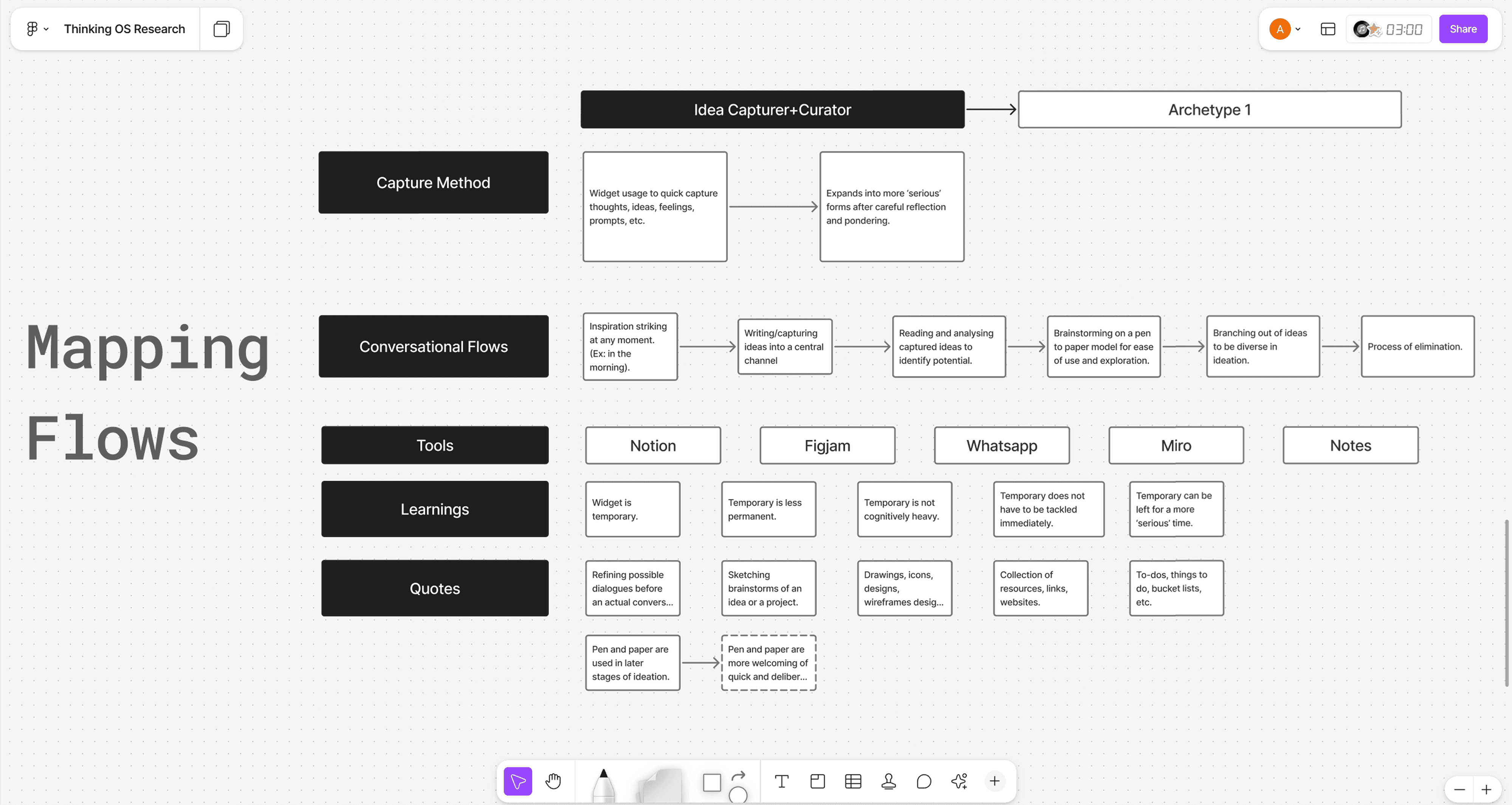
Mapping flows and systems that users utilise to store and access information.
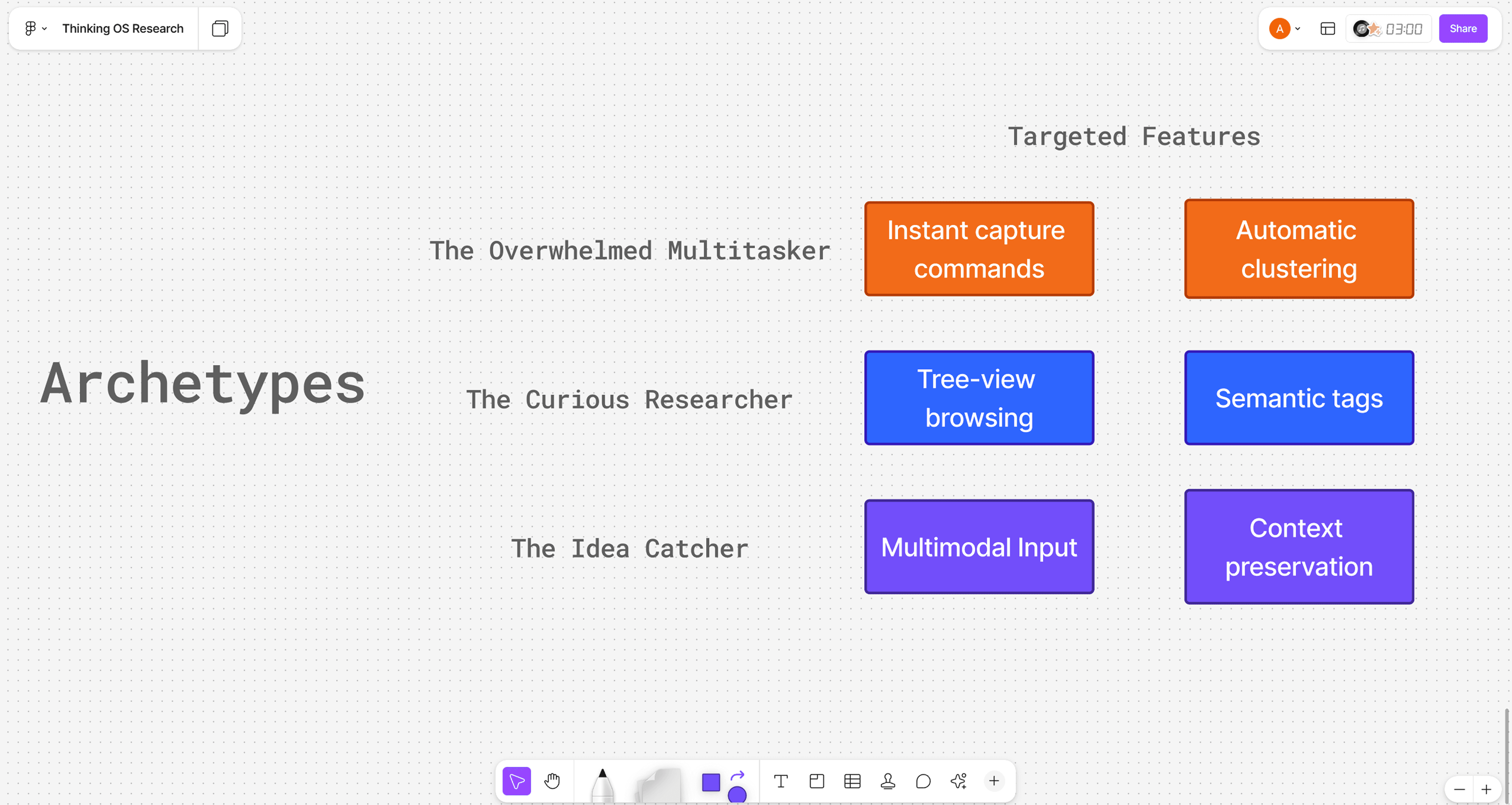
Visualizing archetypes and targeted features for effective research workflows.
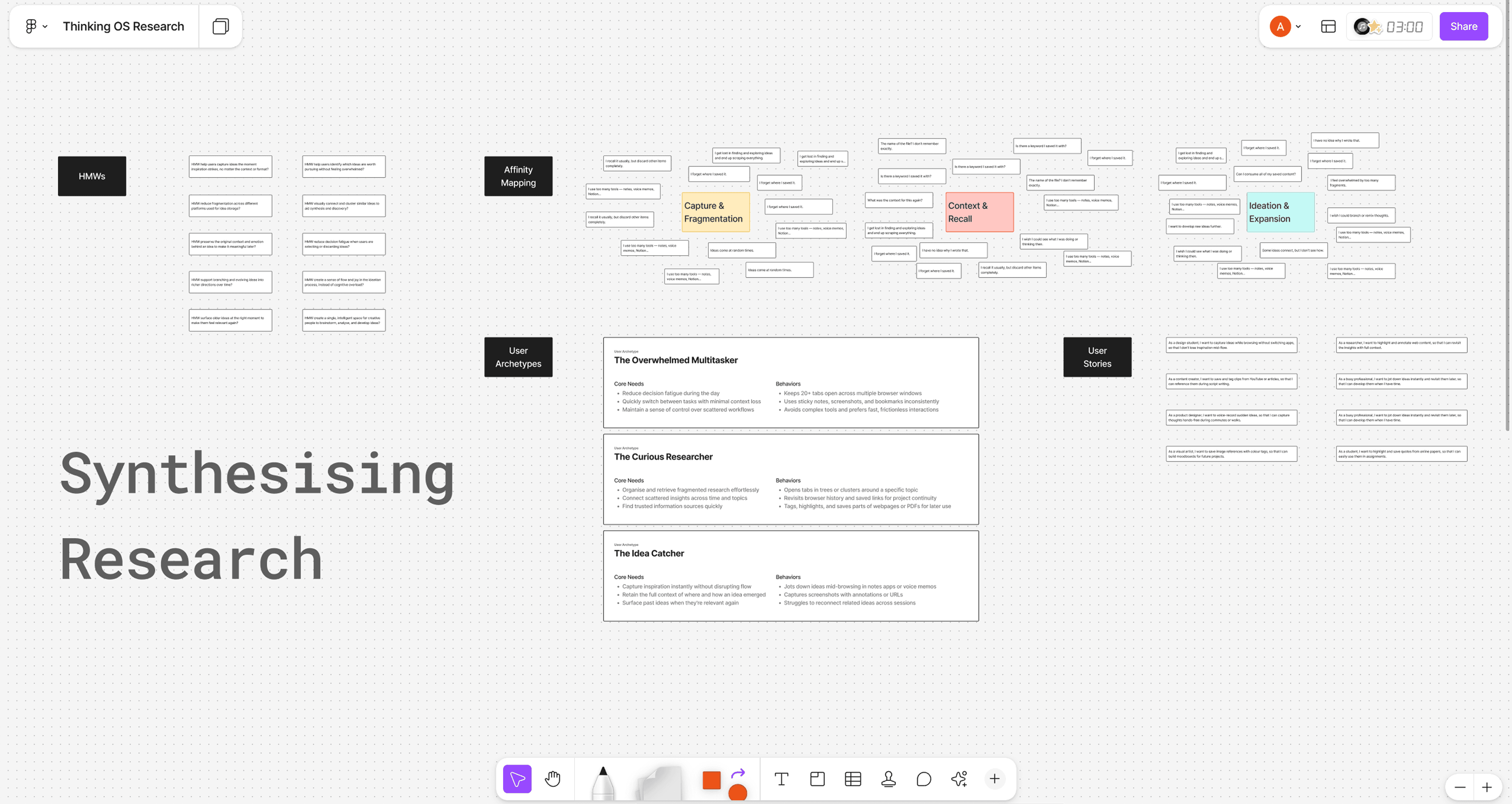
Synthesizing research data for clearer insights using mapping and theme coding.
Mapping flows and systems that users utilise to store and access information.
Visualizing archetypes and targeted features for effective research workflows.
Synthesizing research data for clearer insights using mapping and theme coding.
Mapping flows and systems that users utilise to store and access information.
Visualizing archetypes and targeted features for effective research workflows.
Synthesizing research data for clearer insights using mapping and theme coding.
Mapping flows and systems that users utilise to store and access information.
Visualizing archetypes and targeted features for effective research workflows.
Synthesizing research data for clearer insights using mapping and theme coding.
Mapping flows and systems that users utilise to store and access information.
Visualizing archetypes and targeted features for effective research workflows.
Synthesizing research data for clearer insights using mapping and theme coding.
Mapping flows and systems that users utilise to store and access information.
Visualizing archetypes and targeted features for effective research workflows.
Synthesizing research data for clearer insights using mapping and theme coding.
Mapping flows and systems that users utilise to store and access information.
Visualizing archetypes and targeted features for effective research workflows.
Synthesizing research data for clearer insights using mapping and theme coding.
Mapping flows and systems that users utilise to store and access information.
Visualizing archetypes and targeted features for effective research workflows.
Synthesizing research data for clearer insights using mapping and theme coding.
Mapping flows and systems that users utilise to store and access information.
Visualizing archetypes and targeted features for effective research workflows.
Synthesizing research data for clearer insights using mapping and theme coding.
Mapping flows and systems that users utilise to store and access information.
Visualizing archetypes and targeted features for effective research workflows.
Synthesizing research data for clearer insights using mapping and theme coding.
Mapping flows and systems that users utilise to store and access information.
Visualizing archetypes and targeted features for effective research workflows.
Synthesizing research data for clearer insights using mapping and theme coding.
Mapping flows and systems that users utilise to store and access information.
Visualizing archetypes and targeted features for effective research workflows.
Synthesizing research data for clearer insights using mapping and theme coding.
Design Response
Emergence of a system that lets you be you.
Emergence of a system that lets you be you.
Emergence of a system that lets you be you.
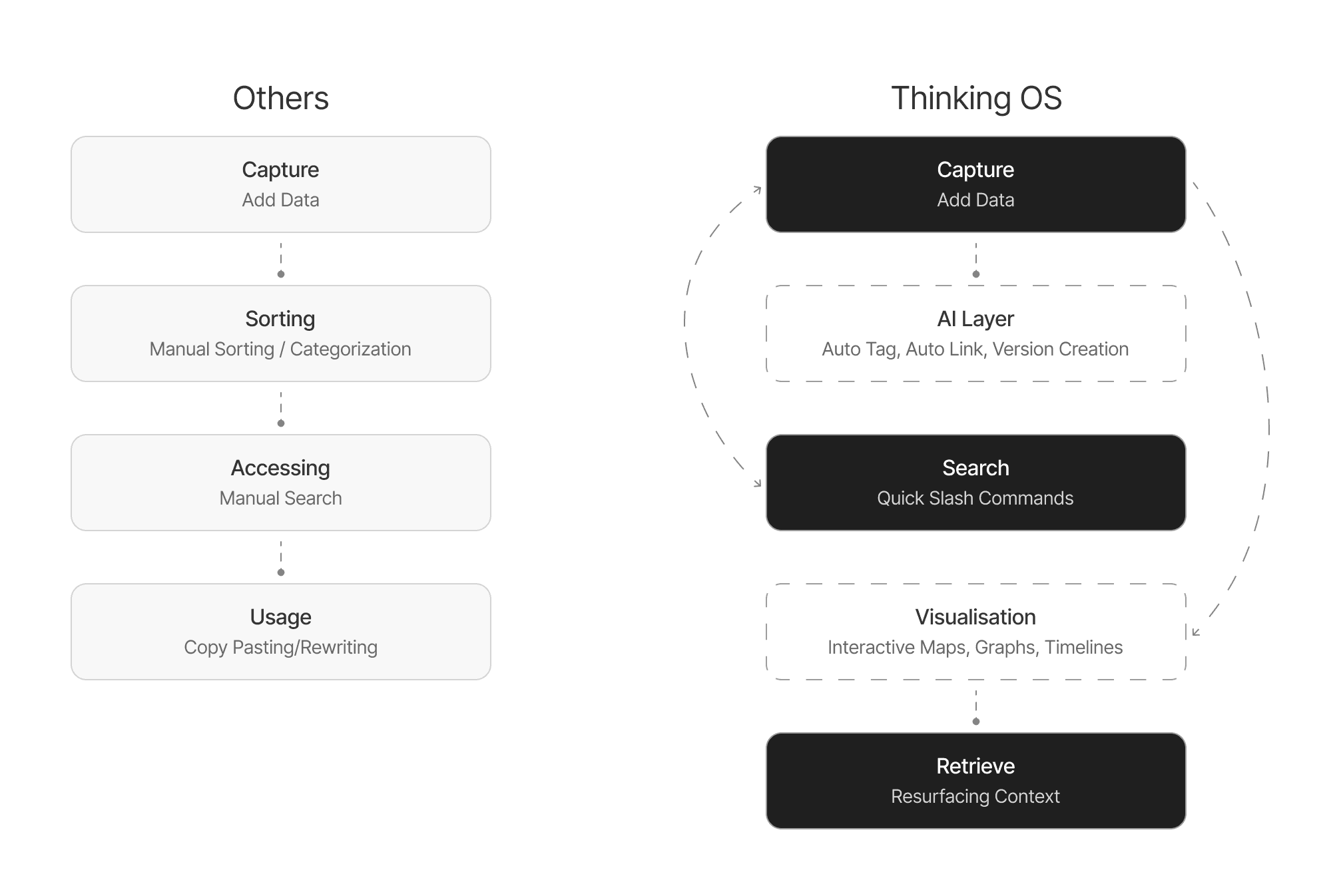
From the three archetypes, a pattern emerged: scattered capture, weak context, and no clear path from idea to synthesis.
Thinking OS is my answer to this gap. A semantic thinking infrastructure that sits in the background while you breeze through writing, accessing, and creating.
From the three archetypes, a pattern emerged: scattered capture, weak context, and no clear path from idea to synthesis.
Thinking OS is my answer to this gap. A semantic thinking infrastructure that sits in the background while you breeze through writing, accessing, and creating.
From the three archetypes, a pattern emerged: scattered capture, weak context, and no clear path from idea to synthesis.
Thinking OS is my answer to this gap. A semantic thinking infrastructure that sits in the background while you breeze through writing, accessing, and creating.
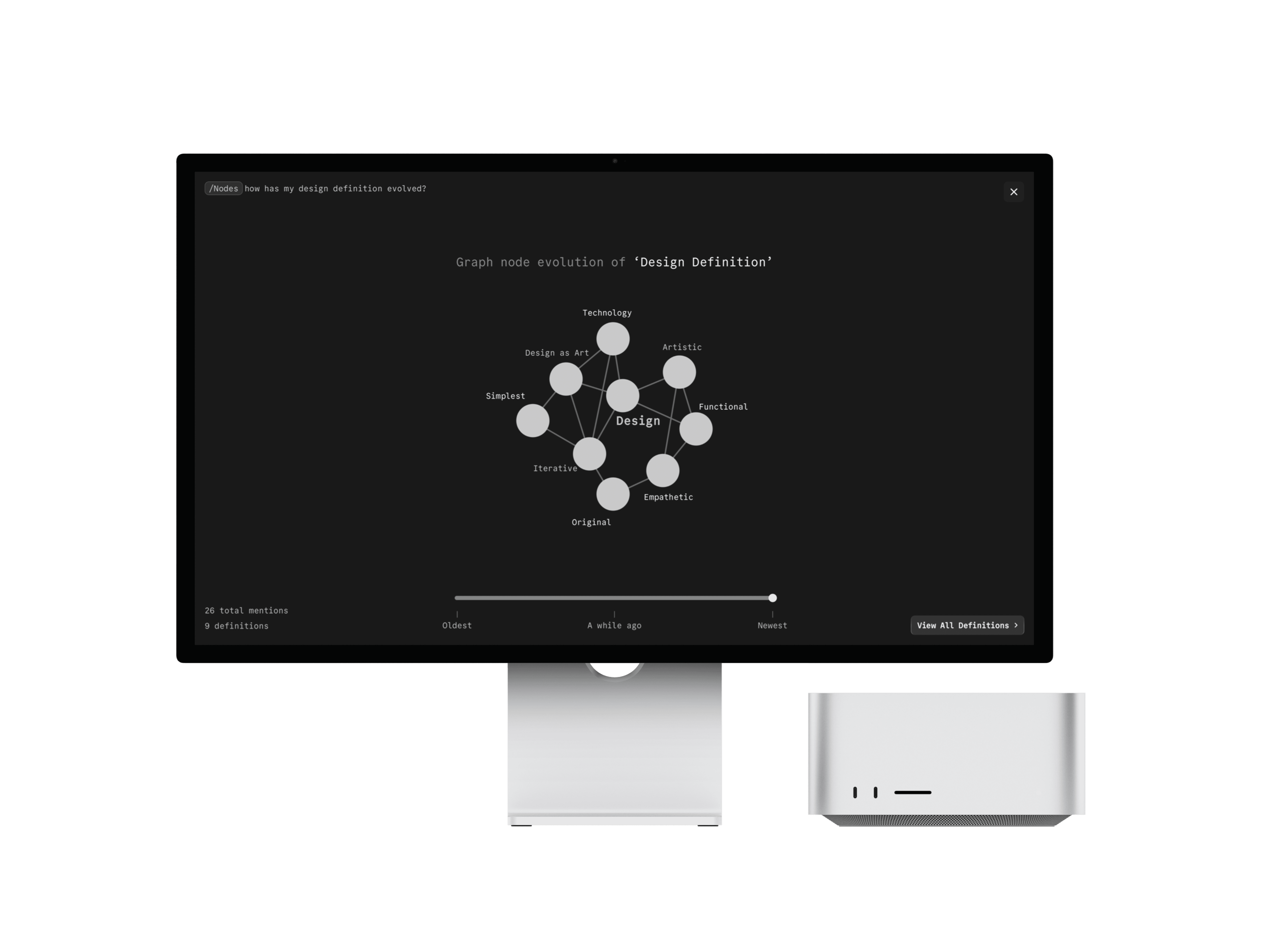
Thinking OS introduces an AI layer that auto-tags, links and versions every input while leaving full control of content and originality to the user.
Thinking OS introduces an AI layer that auto-tags, links and versions every input while leaving full control of content and originality to the user.
Thinking OS introduces an AI layer that auto-tags, links and versions every input while leaving full control of content and originality to the user.
Its generative, visual frameworks like maps, graphs, and timelines let you see and navigate your ideas in the way that best suits your thinking style.
Its generative, visual frameworks like maps, graphs, and timelines let you see and navigate your ideas in the way that best suits your thinking style.
Its generative, visual frameworks like maps, graphs, and timelines let you see and navigate your ideas in the way that best suits your thinking style.
Core Interactions
What Thinking OS does…
What Thinking OS does…
What Thinking OS does…
Some of these were prototyped using code and a local LLM to test basic functionality, including slash commands to define custom actions and auto tagging.
Some of these were prototyped using code and a local LLM to test basic functionality, including slash commands to define custom actions and auto tagging.
Some of these were prototyped using code and a local LLM to test basic functionality, including slash commands to define custom actions and auto tagging.
Information the way you like it
Use '/' and visualise the data you want in any way
/|
/Nodes
Creates nodes of connected ideas
Adds all data into graphs for easier understanding
Resurfaces all visual context from time of capture
Shows how idea has evolved over time
/Graph
/Context
/Timeline
Information the way you like it
Use '/' and visualise the data you want in any way
/|
/Nodes
Creates nodes of connected ideas
Adds all data into graphs for easier understanding
Resurfaces all visual context from time of capture
Shows how idea has evolved over time
/Graph
/Context
/Timeline
Visualize your info
Use '/' and visualise the data you want in any way
/|
/Nodes
Creates nodes of connected ideas
Adds all data into graphs for easier understanding
Resurfaces all visual context from time of capture
Shows how idea has evolved over time
/Graph
/Context
/Timeline
Intelligent Search
Just ask for what you need with all the original context.
Design technology is the at the forefront of innovation
METADATA
DETAILS
Time
Captured on 9 February 2025, 2:16 PM
/Resurface design technology definition
Intelligent Search
Just ask for what you need with all the original context.
Design technology is the at the forefront of innovation
METADATA
DETAILS
Time
Captured on 9 February 2025, 2:16 PM
/Resurface design technology definition
Intelligent Search
Just ask for what you need with all the original context.
Design technology is the at the forefront of innovation
METADATA
DETAILS
Time
Captured on 9 February 2025, 2:16 PM
/Resurface design technology definition


Multimodal Input
Drag and drop any data item from anywhere
Multimodal Input
Drag and drop any data item from anywhere
Multimodal Input
Drag and drop any data item from anywhere
It transforms your fragmented notes into a living memory system focused on meaningful retrieval, not mindless capture.
Thinking OS
34,000 words until 16 May, 2025
A
From 16th August, 2024
Home
Spaces
Design
Trace my definition of ‘design’

Auto creates spaces
You never have to organize your data. Just type and forget everything else.
It transforms your fragmented notes into a living memory system focused on meaningful retrieval, not mindless capture.
Thinking OS
34,000 words until 16 May, 2025
A
From 16th August, 2024
Home
Spaces
Design
Trace my definition of ‘design’
Auto creates spaces
You never have to organize your data. Just type and forget everything else.
It transforms your fragmented notes into a living memory system focused on meaningful retrieval, not mindless capture.
Thinking OS
34,000 words until 16 May, 2025
A
From 16th August, 2024
Home
Spaces
Design
Trace my definition of ‘design’
Auto creates spaces
You never have to organize your data. Just type and forget everything else.
Collections that think with you
Every media you drag in is automatically linked, tagged, and surfaced with context
Collections that think with you
Every media you drag in is automatically linked, tagged, and surfaced with context
Visual Collections
Media that is linked, tagged, and saved
What Was Achieved
To me, Thinking OS has already begun to illustrate how tools for thought can evolve from simple note-taking apps into idea ecosystems.
To me, Thinking OS has already begun to illustrate how tools for thought can evolve from simple note-taking apps into idea ecosystems.
To me, Thinking OS has already begun to illustrate how tools for thought can evolve from simple note-taking apps into idea ecosystems.
Early feedback from peers and mentors highlighted a strong appetite for a tool that bridges capture and synthesis.
Early feedback from peers and mentors highlighted a strong appetite for a tool that bridges capture and synthesis.
Early feedback from peers and mentors highlighted a strong appetite for a tool that bridges capture and synthesis.
This project forced me to move beyond UI screens into system-level thinking. I designed the infrastructure as well as the interface.
This project forced me to move beyond UI screens into system-level thinking. I designed the infrastructure as well as the interface.
This project forced me to move beyond UI screens into system-level thinking. I designed the infrastructure as well as the interface.
Where It's Headed
This project sets a foundation rather than a finish line. Potential next steps include:
This project sets a foundation rather than a finish line. Potential next steps include:
This project sets a foundation rather than a finish line. Potential next steps include:
Prototyping a focused MVP around one key feature.
Prototyping a focused MVP around one key feature.
Prototyping a focused MVP around one key feature.
User testing with designers, researchers, and writers to refine workflows.
User testing with designers, researchers, and writers to refine workflows.
User testing with designers, researchers, and writers to refine workflows.
Exploring integrations with existing tools to test real-world value.
Exploring integrations with existing tools to test real-world value.
Exploring integrations with existing tools to test real-world value.
Iterating through other interaction models to explore diverse use cases.
Iterating through other interaction models to explore diverse use cases.
Iterating through other interaction models to explore diverse use cases.
My Learnings
What attempting to set a foot into this space has taught me…
What attempting to set a foot into this space has taught me…
What attempting to set a foot into this space has taught me…
Although Thinking OS was developed as a conceptual project, it has helped me understand the immense amount of groundwork that needs to be done before designing any software.
Due to the explorative nature of the space, this case study allowed me to experiment with new interaction models, test the limits of AI-assisted thinking, and refine my own systems-thinking approach.
Although Thinking OS was developed as a conceptual project, it has helped me understand the immense amount of groundwork that needs to be done before designing any software.
Due to the explorative nature of the space, this case study allowed me to experiment with new interaction models, test the limits of AI-assisted thinking, and refine my own systems-thinking approach.
Although Thinking OS was developed as a conceptual project, it has helped me understand the immense amount of groundwork that needs to be done before designing any software.
Due to the explorative nature of the space, this case study allowed me to experiment with new interaction models, test the limits of AI-assisted thinking, and refine my own systems-thinking approach.
System-Level Thinking
I learned to design not just an interface but an ecosystem, mapping flows and mental models.
System-Level Thinking
I learned to design not just an interface but an ecosystem, mapping flows and mental models.
System-Level Thinking
I learned to design not just an interface but an ecosystem, mapping flows and mental models.
Storytelling Through Design
Developed a narrative-driven approach to showcase the “why” behind everything.
Storytelling Through Design
Developed a narrative-driven approach to showcase the “why” behind everything.
Storytelling Through Design
Developed a narrative-driven approach to showcase the “why” behind everything.
AI as Augmentation
AI as a supporting layer for human-defined concepts, not a content generator.
AI as Augmentation
AI as a supporting layer for human-defined concepts, not a content generator.
AI as Augmentation
AI as a supporting layer for human-defined concepts, not a content generator.